


Executive Summary
Measurement chaos is not a bug in the $1 trillion global advertising ecosystem. It is a feature deeply embedded in the financial and operating relationships among brands, publishers, agencies, and data providers that impedes brands’ growth and the effectiveness of their marketing investments. Today, measurement remains mainly an after-the-fact assessment of “did we get what we paid for,” an orphan in a universe of marketing analytics so siloed that it greatly limits the intelligence marketers can apply to and the value they derive from their campaigns. As marketing channels, data sources, and data types continue to proliferate, models from other industries and AI tools already in the market are now demonstrating how measurement can be fully unified into the end-to-end development, execution, and optimization of marketing campaigns.
Like nine out of ten doctors, four out of five dentists, and choosy moms everywhere, virtually all marketing professionals can agree on one thing: marketing, media, and advertising measurement are hopelessly broken. But that’s where the harmony ends, as the global marketing-media-measurement ecosystem remains mired in a decades-long debate about how to treat chronic “mediameasurementitis”, the malady that causes most industry executives to repeat with Tourette-like consistency, “I don’t know whether my ad spend is effective!”
But there is a new path forward. It’s not about getting “industry agreement” on shifting media “currency” from gross rating points to “attention,” “behaviors,” “outcomes,” or other metrics so fashionable today. Rather, the remedy to the persistent chaos is to release audience and advertising measurement from the marketing and media penalty box to which it’s long been exiled, and make it a component of a unified, end-to-end, AI-driven service-as-software solution. Such solutions will transform the current environment of fragmented and disconnected tools and data into a holistic base of insights, intelligence, execution, and optimization. Marketers will be able to acquire, unify, customize, act on, and optimize the myriad signals that matter for their respective businesses and marketing use cases.
Too wildly difficult, you say? Think again. AI tools already in the market are rendering this assimilation of media measurement into marketing strategy and execution not only inevitable, but soon a must-have for profitable revenue growth.
Such tools are creating a class of solution that brand marketers have long craved, even if they couldn’t articulate it. We refer to this burgeoning software solutions category as Marketing-Advertising-Media -Measurement-Analytics (MAMMA).
And MAMMA is ready for her moment.
The Measurement Mess
Marketing’s reliance on advertising and its GRP currency is a relic of the Industrial Era, cut from the same one-size-fits-all cloth as Ford’s Model T car and Procter & Gamble’s Ivory Soap. Like these machine-made products, media and advertising consisted of standardized commodity offerings that comprised interchangeable parts sold to a mass audience.
The pioneers of media measurement did not start out with the goal of identifying a single currency for media advertising. Frank Stanton and Paul Lazarsfeld, PhDs in psychology and mathematics, respectively, and the joint inventors of the first media audience analyzer in the 1930s, were more interested in determining both quantitatively and qualitatively how media influenced consumer behavior. But by the 1950s, attempts at quantification dominated, reflecting the ascendency of national television as the principal advertising medium for large consumer brands, the enormous sums of marketing dollars flowing into the medium, the acceptance of the A.C. Nielsen Company’s meters and diaries as the standard system for television measurement, and the simplification of advertising value into two metrics that Nielsen’s meters and diaries claimed to be able to count: the estimated number of people to whom a provider’s advertisements were delivered (reach) and the estimated number of times those ads crossed the consumer’s field of view (frequency). These were reduced into the standardized currency - the gross rating point (GRP) - and its pricing mechanism, the CPM, or cost-per-thousand impressions delivered, that still dominates advertising transactions 75 years later.
The accuracy and probity of these measurement and pricing systems has been fraught with controversy for nearly as long. “Many broadcasters have been taken in by many ratings services. Perhaps some of the broadcasters did not mind too much being taken in,” Rep. Oren Harris of Arkansas concluded after leading Congressional hearings on the ratings industry in 1963. Broadcast ratings, he said, were “false or at least misleading.”
Brands, in particular, have remained largely saddled to and overly focused on that rating system and the commodity currency it birthed. As TVREV’s Alan Wolk shows in an insightful whitepaper, they have created parallel data systems, one for reach and frequency, another for various measures of marketing effectiveness, thus divorcing their procurement decisions from the actual value of the marketing investment.
Even as industries as diverse as agriculture, energy, and financial services evolved from offering commodities to offering solutions - bundled offerings designed to solve a customer’s specific problem or achieve a desired outcome - the marketing-media-measurement ecosystem has remained mired in commodity economics and processes. Brands have been unable to assimilate, let alone respond to, most of the questions one would assume are vital in marketing: Do consumers prefer our product over competitors’, and if so, why? Did our marketing efforts reach the right audiences? Did the audiences react in the desired ways? Did our retail traffic or sales patterns reflect our marketing inputs, or point toward other sources of influence?
In the parlance of the digital era, measurement hasn’t been used as one of many “signals” for guiding the development, management, and optimization of marketing strategies. It has been an orphan dataset, overwhelmingly deployed to negotiate pricing with and hold media partners accountable for delivery commitments.
Remedying mediameasurementitis is rendered more complex when innovation in metrics and analytics is taken into account. Nearly 10,000 companies currently are operating in the global ad tech sector, with 405 new ones launching each year, according to the research firm Tracxn. These companies perform numerous tasks up and down the marketing-media value chain, including supply and demand forecasting, creative iteration, personalization, pricing, placement, procurement, performance management, privacy and security assurance, quality control, brand safety, brand appropriateness, attention analysis, cross-platform integration, outcomes measurement, optimization, and data management, for all manner of mediums – video, audio, banners, search, social platforms, and more.
And this doesn’t begin to include the tens of thousands of other companies that track customers and their behaviors, retail sales, specific market sectors, and other activities across the media-marketing-retailing- consumption value chain.
Notably, all these companies throw off data that can be used to assess and improve the performance of marketing and advertising campaigns, and, ideally, accomplish the task that Lazarsfeld and Stanton set for themselves in the 1930s: discover which specific marketing activities are contributing the most to profitable revenue growth.
Unfortunately, the tools that marketers use today to plan, purchase, place, assess, and optimize their marketing are as siloed as their sources of data, preventing the assimilation of all this information into testable and actionable marketing plans.
“What we have now,” the head of media procurement at one of the largest global consumer brand marketers told us recently, reflecting on the debacle that is marketing measurement, “is the best of the shit solutions.”
Other Markets, Other Models
Certainly, we are all familiar with technology systems that take data from disparate sources and harness it to address individual needs and use-cases. In fact, everyone reading this has one in their pocket: It’s called an iPhone.
iPhones (and their Android competitors) are ready examples of three intersecting developments that have transformed business (as well as personal life): data unification, customization, and workflow automation. Entire industries have been revolutionized by software and hardware dashboards that enable their convergence. In finance, terminals like Bloomberg allow access and convergence of market data, financial statements, newsfeeds, macro datasets, the development of portfolio strategies and scenario models, and the execution of trades. Digital farming dashboards like Climate Fieldview help farmers collect, store, visualize, and analyze field-level data to make more informed farming decisions. The music industry has been reshaped by the development of Digital Audio Workstations like Pro Tools and Logic Pro that draw from a public marketplace of nearly 25,000 standardized plug-ins from hundreds of developers to enable people to create (and profit from) music, from ideation through to finished production and distribution.
Such cross-functional solutions have been penetrating the marketing function for years. All of them share at least some of the following characteristics: unification of data, large open marketplaces of plugins allowing for extensive customization, workflow consolidation and automation, and individual control. For example, data clouds like Snowflake allow the management, governance, and analysis of data from disparate sources. CRM systems like Salesforce can merge otherwise siloed customer contact, sales, and journey data, and offer access (as Salesforce does) to a marketplace of thousands of apps that extend the tool’s functionality. DSPs such as The Trade Desk help advertisers and their agencies create and execute media strategies, from planning to procurement to post-campaign measurement against KPIs.
But virtually all media and marketing solutions have lacked at least some of five essential characteristics: simplicity, comprehensiveness, decisioning, execution, and the ability to effectively integrate measurement into the operational mix, rather than leaving it on the sidelines. Today’s marketing environment has millions of channels, from individual influencers and niche mobile apps to vast black-box platforms like Meta and Google, that drive consumers not just to giant chains like Walmart, but to nearly 12 million e-commerce sites in the U.S. New forms of measurement and analysis that were impossible a decade ago are now not just available, but available in near-real time. Given the proliferation of measurement, analysis, creative tools, media options, and retail channels, each marketing plan can be - and to realize optimum returns should be - unique, with success factors that can be isolated, measured, understood, implemented and adapted.
“The desire to unify measurement is there, and at least some of the capabilities exist to take in all the relevant signals you need into one repository and analyze them,” says Jonah Goodhart, the founder of the advertising analytics firm Moat and now the CEO of Mobian, an AI startup specializing in contextual advertising measurement, targeting, brand safety, and suitability. “The question now is, can we find a simple way to bring together all this data and ask natural-language questions of it?”
Thanks to AI, the answer is yes. As Professors Rajkumar Venkatesan of the University of Virginia’s Darden School of Management and Jim Lecinski of Northwestern University’s Kellogg School of Management note in their forthcoming second edition of The AI Marketing Canvas: A Five-Step AI Plan For Marketers, AI tools in the market today, using statistical modeling, deep learning, neural networks, and such machine learning techniques as regression, dimensionality reduction, classification, and clustering, are already doing some of what we consider the five essential tasks of MAMMA:
Enabling the integration and continuous analysis of innumerable datasets, which historically has been too expensive and labor-intensive to pursue
Allowing the near-real-time testing of scenarios premised on these analyses
Developing insights, long-term memory / intelligence, and qualified solutions based on these analyses and scenario tests
Overseeing execution across the marketing supply chain, from insights to creative development and execution to media distribution to measurement to optimization
Creating a feedback loop that measures the market results and uses the metrics to continuously improve the models and decisions
Such comprehensive AI-driven solutions that cover large swaths of a company’s critical business processes have a name: service-as-software. Service-as-software (not to be confused with SaaS), is a business model where companies deliver fully automated services—powered by AI—rather than merely providing software tools for customers to use. Instead of giving customers a machine to help them do the work, the software does the work for them.
The AI Disruptors
MAMMA is a service-as-software solution for the marketing-media- measurement ecosystem, enabled by tools already in or coming into the market and fueled by the leading AI companies.
Of the nearly 7,000 unique AI agents that we estimate populate seven of the top agent marketplaces (AI Agents Directory, Agent.ai, AI Agent Store, AgentLocker, AWS Marketplace, Salesforce AgentExchange, and Moveworks AI Agent Marketplace), more than 1,700 appear related to core functions in the marketing-media value chain. Hundreds of these are agentic point solutions, addressing needs in a single step of the chain - avatar creation for online customer-service engagement, for example. Scores address step solutions, integrating multiple functions at incremental stages in the value chain, such as streamlining and automating workflows for Search Engine Optimization across such functions as keyword research, content generation, results analysis, and optimization.
But look closely and you will see that ad tech, martech, CRM and sales tech, experience tech, and creative tech are blending together in journey orchestration suites - AI applications that unify and automate wider sections of the value chain for brands both large and small, as well as for publishers and agencies.
Smartly.io, for example, uses deep learning models and generative AI to bring together creative, media execution, and performance intelligence drawn from multiple distribution channels, including social media, CTV and the open web, with the aspiration to deliver comprehensive customized advertising campaign management.
“From the beginning of digital advertising, we understood that consumers want brands to engage with them in a different way,” Laura Desmond, the company’s CEO and the former CEO of Starcom Mediavest, told us. “That led first to smarter media planning, then to tracking and cookies, then to DSPs. And at each step along the way, consumers responded with, ‘No, you’ve got to respect me, too.”
“Creative is the missing part of that value proposition, and that’s what we add,” she says. “Our platform generates 92 billion data points a day. We know what’s working and we can assemble and generate creative assets in real time, as we discover what people are looking for, shopping, and buying.”
Another potential MAMMA model is Adaly.ai, which calls itself an “enterprise intelligence platform.” It integrates LLM and ML functionality across external and internal data sources (Adobe, Snowflake, Salesforce, SAP, etc.). This helps users discover new interdependencies while eliminating entirely the need for complex data lakes, speeding up the development of market and customer insights, advertising creative generation and testing, analytics, media procurement, and campaign scheduling.
The company’s founder and CEO, Kyle Csik, a longtime agency digital operations leader, says a key part of Adaly’s value proposition is its ability to securely grant visibility into an entire organization without the burden of data lakes, unlock the discovery of previously unknown business drivers, enable automation of business functions, and free up capital that can be then be invested in business outcomes instead of data-wrangling.
“We have an opportunity to focus organizations around the spine of how they operate - which is selling their products - instead of investing cost and labor on the ancillary circle of activity that costs them billions, to just have people push buttons,” he said.
Another exciting MAMMA prototype we have seen is Veylan. Veylan, which serves agencies and publishers as well as brands, describes itself as an AI-native operating system for advertising, unifying fragmented ad workflows (media, creative, planning, analytics) into a seamless, data‑driven platform. Its neural network mechanism absorbs all enterprise data and brings it together with relevant and accessible external data, essentially creating an AI model of the business. It then deploys five types of autonomous agents (for strategy, planning, creative, ad ops, and trading) to help orchestrate nearly every aspect of a company’s marketing - strategy, creative, distribution management, budgeting, performance monitoring, reporting, and optimization.
Anthony Iacovone, Veylan’s co-founder and CEO, who previously founded the DSP Adtheorent, believes - as do a surprising number of tech-centered marketing AI founders - that Veylan’s system will unleash more human ingenuity in marketing.
“The future, we believe, will be a lot of free, self-driving agents, with humans serving as editors, looking and monitoring, guiding and directing,” he told us. “The brand can now have complete control of business intelligence and direct its agency and publishing partners from a centralized place.”
The MAMMA prototypes we have encountered recently center mostly on the development and automation of digital display, social marketing and search-engine campaigns. But video (especially CTV) has already entered their media mix, and full data unification and decisioning across media types is rapidly developing. The companies overlap in capabilities but differ in emphases. Smartly and Promarkia, for example, stress their creative execution functions. Adaly, Newton Research, Funnel.io, and Measured highlight their measurement and attribution capabilities. Veylan, Mobian, and Prescient.ai lean more toward their media planning and placement uses. But to be sure, the movement in the AI marketplace is toward multi-functionality, not toward point-specialization.
The most exciting movement, though, may be the grail that brands have been seeking since the earliest days of modern marketing: definitive attribution. Although we haven’t seen it yet in practice, AI MAMMAs’ ability to regress and test literally thousands of scenarios in minutes or hours promises to allow brands to isolate discrete sources of brand lift and cleanly correlate those sources to sales, sales by channel, even sales-by-price-by-channel.
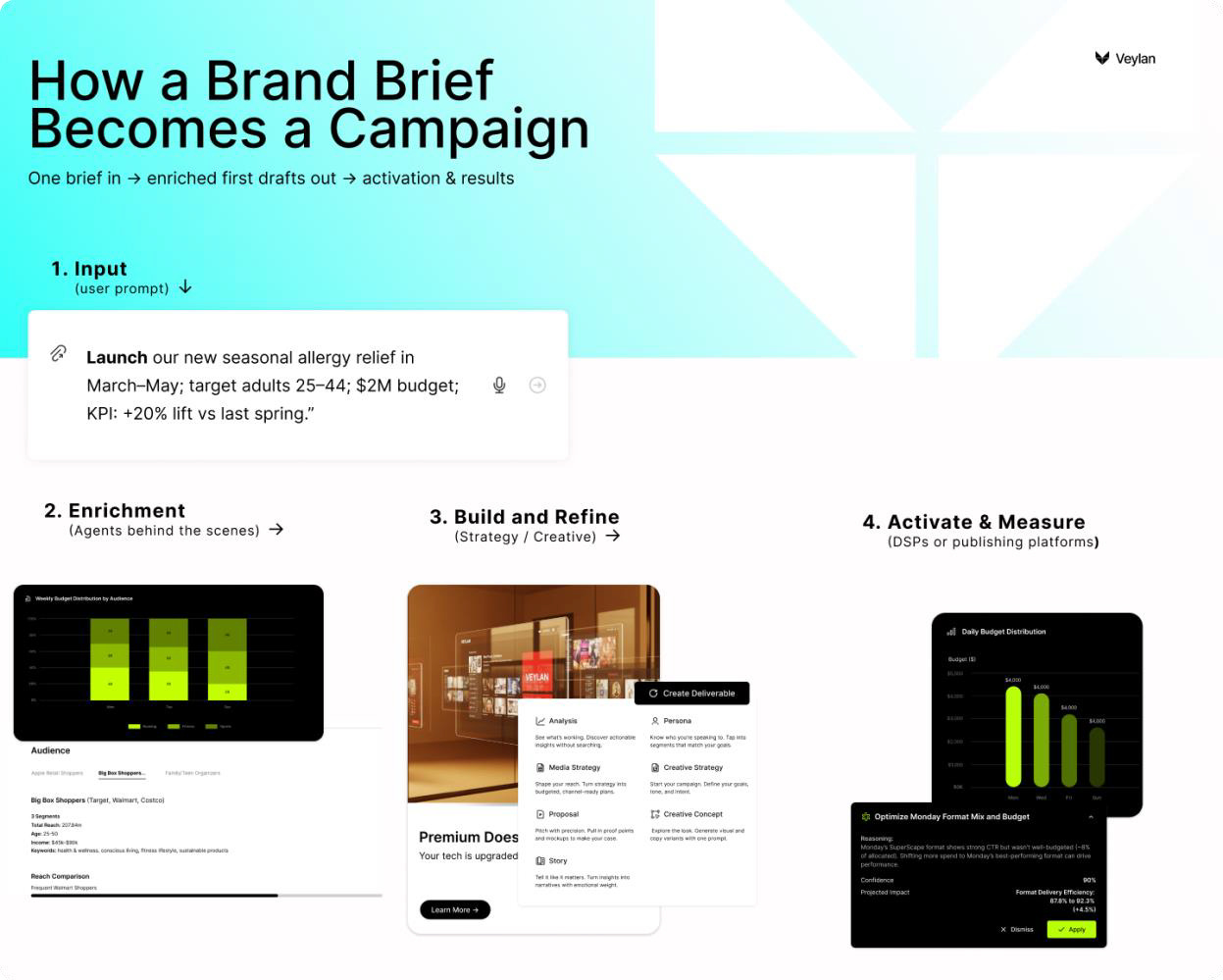
In practice, most of these MAMMAs look deceptively simple - a byproduct of the natural-language querying and background modeling (regression or otherwise) that AI LLMs and agents built on them allow (see illustration below). Using Veylan, for example, a user at a brand, publisher, or agency can:
Start with a prompt: Describe a broad initiative (“positioning strategy for an athletic fashion brand”) or get ultra-specific (“campaign for 18–25 year old men riding Ubers on Thursday evenings, optimized for iPhone delivery, with Facebook + Spotify as primary channels”)
Ingest and fuse data: Pull from internal CRM, creative, and media systems. Supplement with syndicated media data, analyst reports, industry news — whatever the user requests. Combine it all into a working model of a brand’s and market’s context
Build and refine: Strategies (generate initial positioning, creative briefs, media plans, KPIs). Collaborations (users guide the system, refining strategy, creative, and budget allocations in real time). Deliverable drafts (first-draft creative assets - images, copy, video — on-brand, ready to review)
Execute and optimize: Distribute assets via connected DSPs or publishing platforms. Measure results using third-party systems like Nielsen, EDO, or internal metrics. Adjust strategy, creative, and spend based on live performance data
Provide full transparency and control: Ask questions like “What’s your evidence for that recommendation?” Set data boundaries, override decisions, and substitute users’ own insights
All actions, assumptions, and data sources are queryable, editable, and explainable. Recommendations generated by the system can be probed by simple queries, such as, “What’s your supporting evidence for that?” Users and teams can put limits on the data employed by the model, to gain confidence. They can intervene to examine the underlying evidence against other sources to which they have access, override recommendations, test scenarios, and substitute their own insights as they emerge from the campaign’s progress.
In other words, MAMMAs are not HAL - or shouldn’t be. They aren’t substitutes for human ingenuity or creativity, but boosters of both.
Among the most important things we learned from this months-long tour of the development of MAMMA capabilities is what we did not hear from any of the founders and leaders: Not one spoke of measurement as anything other than a data source meant to improve brand performance and growth. And not one mentioned the word “currency.”
If there is a missing link in the MAMMA scenario, it might be in the availability of significant datasets. Unlike the music industry’s Digital Audio Workstations, in which plugins are relatively inexpensive, ranging from free to several hundred dollars each, marketing and media data historically has been a closed, narrow, and expensive offering. Thus, marketing data costs have remained a barrier to entry for both smaller brands and specialized data providers.
We anticipate that, as MAMMA service-as-software solutions begin to unify data, decisioning, and management for brands, curated marketing data marketplaces will develop that are safe, fair, transparent, and offer customers opportunities to share guidance about the qualities and qualifications of their metrics and analytics “plug-in” providers. These marketplaces could drive down the costs of data, while leading to increased participation, especially among SMBs. Indeed, the longest-running incumbent of all, Nielsen, recently launched such a marketplace.
To be sure, such changes could upend the economics of media and marketing that have prevailed for more than a century. Taking the long view, that status quo has been dying off for at least 40 years. From the death of magazine rate cards in the 1980s to the Google AdWords search auction in the early 2000s to programmatic advertising today, media economics has been mimicking the shift from commodity processes and economics to value-based solutions and pricing that we have observed in other industries, creating opportunities for SMBs to compete more aggressively with longtime consumer category leaders.
“AI data tools like Veylan allow SMB’s to become very powerful businesses,” Anthony Iacovone told us. “They allow the small brand to have the capability level of the largest agencies and companies across the board.”
The Incumbents’ Dilemma
It’s hard to imagine why brands and their partners in the marketing- media-measurement ecosystem would not immediately pursue MAMMA solutions, given their obvious potential to lower marketing costs and enhance growth (not to mention their potential to empower more capable competitors).
But old habits die hard. From our observation and from our interviews, marketing professionals are so focused on solutions to immediate financial challenges, like accurately measuring de-duplicated reach or engagement, that they cannot see (or are not prepared to embrace) the transformational opportunity that comes from solutions that unify the hundreds, even thousands, of signals coming into their organization from their supply chains, their consumers, their partners, and the public marketplace.
“The data unification concept didn’t address immediate customer pain points—it felt like a ‘nice to have’ rather than a must-have to solve daily headaches,” one CEO told us of the resistance to his company’s solution. “Customers understood the value conceptually, but weren’t willing to devote careers to solving it, since lack of unified data wasn’t causing immediate money loss.”
To be sure, there are more tangible barriers to the development of the MAMMA market. Some large data providers, such as Nielsen, Meta, and Google, maintain contractual restrictions with clients that prevent data commingling. Smaller providers that work with platforms like Meta also hold back their data from third-party unifiers, for fear that they might fall afoul of such restrictions.
Equally true, brands often don’t know where their data lives—reports go to various systems (Snowflake, Databricks, Salesforce) that don’t easily communicate with each other. And sometimes data ownership is so unclear (does it belong to the brand, the retailer, the agency, someone else?) that brands simply don’t want to spend the time untangling the rights.
Service providers within the marketing-media-measurement ecosystem face their own, discrete challenges adapting to MAMMA orchestration solutions. (See chart below.) In many cases, conventional audience measurement firms, programmatic advertising intermediaries, and advertising holding companies are lagging either in their ability to expand the comprehensiveness of their solutions, or their adoption of agentic or generative automation - or both.
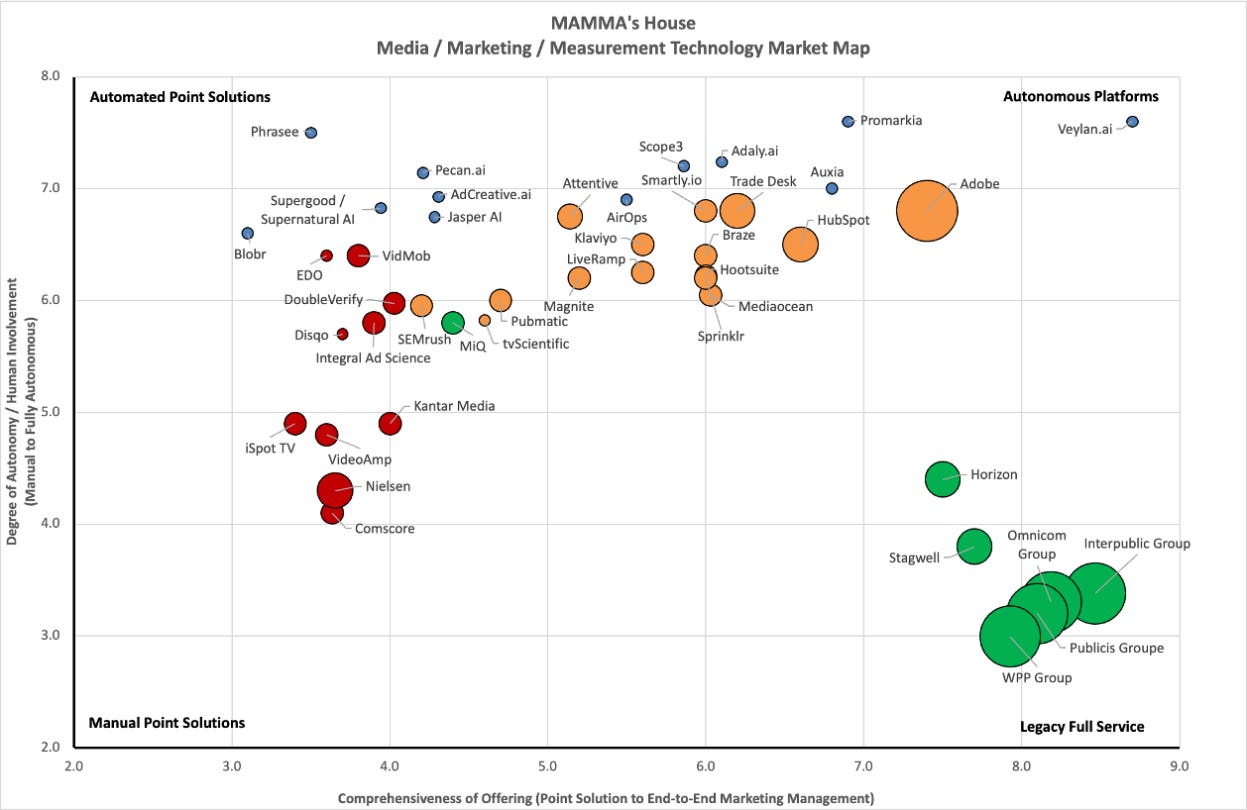
Methodology: The chart maps sets of incumbents and AI-fueled disruptors along two dimensions: comprehensiveness of marketing-services capabilities on the X-axis, from point solutions on the left to full-service suppliers on the right; and AI-centricity on the Y-axis, from labor-intensive companies toward the bottom, to fully automated agentic providers at the top. Functionally, we placed all companies in one or more of the following service categories, comprising 48 subcategories: 1. Strategy and Planning 2. Creative Development 3. Media Operations 4. Technology Infrastructure 5. Distribution and Placement 6. Data and Analytics 7. Fulfillment and Production 8. Financial Operations. The framework combines quantitative metrics with qualitative analysis. We used publicly available information sources, including SEC Filings (10-K, 10-Q, 8-K), Company Websites, Press Releases, News Reports, Trade Publications, and Analyst Reports (Gartner, Forrester, etc.) We used Anthropic’s Claude to conduct a four-phase process that included Data Collection, Category Evaluation, Final Scoring on a 1-10 scale on each dimension, and a Review that explored the evidence standards, scoring consistency, and a validation check of the conclusions.
For these reasons, we hypothesize that the earliest adopters of MAMMA unification and management solutions will be smaller companies without the embedded infrastructure, existing product roadmaps, and or business processes that constrain larger legacy companies.
That being said, the entry into the field by the largest data management and planning / activation incumbents, with their wealth of relationships with leading brands, could speed adoption by larger brands. We would look to several highly capable incumbents that combine technical capabilities, existing product offerings, “neutrality,” and customer relationships across the value chain. Each has its own form of “secret sauce” that sets it apart from others.
Adobe boasts a leading position both in marketing analytics and in creative production, management, and optimization tools, providing the company capabilities and relationships – including the management of a large marketplace of creative resources - that are critical in an ever-more-finely segmented marketing environment, yet often missing from more media-centric ad tech companies. Since early 2025, Adobe has been aggressively introducing MAMMA-like AI-powered functional unification capabilities, such as the Adobe Journey Optimizer.
LiveRamp is the leading industry player in identity solutions and data collaboration, with solutions that are already used, directly or indirectly, by most major marketers, publishers and ad tech companies. LiveRamp’s position as a neutral “Switzerland” and data “connector” helps it work effectively with most participants across the media landscape. Moreover, LiveRamp already has a robust data marketplace, which provides distribution and customer access for a wide range of third-party data providers, and helps marketers leverage that data with other first-party and third-party datasets to build ad planning / targeting, activation, and measurement solutions.
Horizon Media, the largest independent media agency, recently launched a MAMMA-like system that integrates media spend and detailed performance analyses in a simple interface that supports natural language queries. The Trade Desk, as the largest DSP for the open web, enables access to what might be the greatest cache of actionable data outside the walled gardens. Its Kokai AI platform, which had already offered audience segmentation and performance optimization functions, recently introduced generative creative development services. Twenty-year-old Hubspot, a master of affordable CRM systems specifically for SMBs, has been aggressive in introducing AI tools, including Breeze, a suite of AI agents that oversees creative development, content marketing, social media, sales prospecting, and customer service. Mediaocean, a pioneer in the computer-driven administration of budgeting, billing, media planning, and campaign management for advertising agencies, is distinguished by its breadth of customer relationships (especially with all major global ad agencies), end-to-end capabilities across the marketing-media supply chain, and its neutrality from specific procurement decisions, even as it integrates into a large number of DSPs.
We believe leading companies like these will need to step up (if they aren’t already), or risk losing their current market positions to the many AI-fueled startups that are already providing metrics and analytics integration solutions within a suite of other functional capabilities. For these incumbents, our guidance is:
Close the loop, linking measurement into a unified solution with media planning, creative optimization, and sales enablement. Integrating disparate datasets and harnessing generative AI will enable marketers to define and optimize creative and media campaign parameters based on continual learning and KPIs from past campaigns, and adjust them as sales results flow in.
Commit to openness. No one will out-wall today’s walled gardens, but an aggregation of other data sources can provide brands competitive advantage. And data interoperability will grow the market for MAMMA providers.
Build for a million customers, not just the Ad Age 200. The TV-centric marketing industry was built around the 200 leading marketers that contributed more than 80 percent of network television’s revenues. That narrow customer base is unsustainable for publishers, data providers, and others in the marketing ecosystem. The value in marketing’s long tail is immense.
Measurement Can Now Make Sense
Nearly 15 years ago, we - John as a partner at management consulting firm Bain & Co., Randall as the CEO of the IAB, the digital marketing industry trade association - launched “Making Measurement Make Sense” (3MS) along with several partner organizations. The focus of 3MS was on improving the quality of digital metrics and advancing common standards, with the end goals being to raise confidence in digital media investments, facilitating cross-platform measurement, and enhancing overall media and marketing decision-making.
3MS helped move the ball forward. For example, the effort gained widespread agreement that digital media measurement should shift from the served impression to a viewable impression. In addition, it birthed ongoing industry efforts to improve the quality and ROI of digital advertising, via fraud prevention, standards-setting, and cross-platform reach and frequency metrics. However, with the benefit of hindsight, improvements from 3MS can be viewed as largely incremental. Measurement remained focused on currency for media transactions and largely disconnected from marketing decision making.
We set out to revisit 3MS’s legacy this year, recognizing that AI would allow the integration of multiple datasets into both the before-the-fact and after-the-fact development of marketing campaigns, such that measurement no longer had to be an orphan in the universe of analytics.
We were surprised to find that existing AI tools are already in the market and enabling this form of data unification - and that AI is enabling much more than analytics: It is fostering the integration of analytics and predictive decision making and enabling the operationalization (and automation) of those decisions.
While the movement in marketing toward data unification, decisioning, and deployment may be inevitable, it won’t necessarily happen overnight. In many ways, the development of agentic and generative markets is resembling the rise of programmatic technologies in advertising beginning circa 2007. A panoply of point solutions is overwhelming the marketplace, creating confusion inside brand organizations and possibly impeding adoption. The business media in recent weeks has been awash in stories about the disappointments companies are experiencing over their AI investments.
From our conversations among marketers and their partners, we believe the disappointment may derive from a reflexive assumption that they can wave a magic AI wand and immediately reduce giant chunks of costly labor from their internal and external marketing supply chain.
But AI is not magic, it does not automatically do anything, and cost reduction misses the larger opportunity: to find new growth.
Working with AI-focused solution providers like those we’ve identified, or building agents in-house, brands should start immediately testing the opportunities for signal unification from their many internal and external data sources. Find your way to insights and the actions they inspire.
Oh, and one last thing: MAMMA understands you. Listen to MAMMA.
Randall Rothenberg is the former Chief Executive and Executive Chair of the IAB, the digital media and marketing industry trade association; the former Chief Marketing Officer of Booz Allen Hamilton; and the author of Where the Suckers Moon: The Life and Death of an Advertising Campaign (Alfred A. Knopf, 1994). The proprietor of the strategy and marketing consultancy Randall, Ltd., he has served on the Boards or Advisory Boards of EDO, Inc., Digital Remedy, the Ad Council, the Advertising Self-Regulatory Council, the Columbia Journalism Review, and the International Center of Photography.
John Frelinghuysen has served as the Executive Vice President for Digital Media at Disney/ABC Television Group; the Senior Vice President and Head of Strategy at AOL; and as a partner and media practice leader at L.E.K. Consulting, Bain & Company, and Booz Allen Hamilton. He is currently a principal at Frelinghuysen Advisors. He and Mr. Rothenberg were leaders of the cross-industry “Making Measurement Make Sense” initiative.
This piece was first published on WARC on September 22, 2025. The authors gratefully acknowledge WARC and our editor, Stephen Whiteside, for their guidance and support.
This is a fascinating framework that I am not nearly qualified enough to evaluate, however it feels like an ambitious and wide ranging, though necessary "forklift" approach to the media landscape. The paper has references to workflow and Interoperability, areas that I am passionate about, however you know I would be remiss if I didn't say it is missing references to metadata, which is also a key supply chain contributor.